

OurServices
Foundation Repair and Stabilization
Homeowners often wonder how to identify the different signs of foundation problems. It’s definitely a good question to ask. Here’s why – the longer you wait to treat visible signs of damage, the more severe the damage can become. Left untreated, minor cracks and leaks can turn into serious structural issues that compromise the value and overall health of your home.
Your home’s structural integrity depends on the strength of your foundation. It supports everything else – walls, windows, floors, doorways, roof – so when your foundation is damaged, it can cause serious problems throughout your home.
Like most things in life, your foundation is subject to environmental stress. Expanding and contracting soil, excessive moisture and inadequate drainage are some of the most common threats to your home’s foundation. Over time, environmental stress can cause the foundation to shift, crack or settle unevenly. And homeowners can often miss the early warning signs of foundation damage.
Foundation problems can create several issues throughout the home regardless of the foundation type. This includes slab on grade foundations, basements and crawl space homes like pier and beam foundations, or block and base builds.
Fortunately, most of these problems are hardly invisible, and signs of foundation problems need to be recognized and dealt with as early as possible to correct (and sometimes even prevent) major problems quickly.
Stabilization:
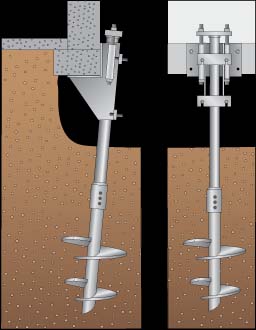
Helical Piers and Pressure Piles
Piling or piering is the technique of driving steel pipe pilings to remedy failing building foundations and to correct foundation settlement.
Push piers consist of sections of galvanized or epoxy-coated steel pipe that are driven into the soil with a hydraulic ram.
Helical piers use screw piles with steel shafts. The lead section, with one or more helixes attached, provides the needed bearing capacity. The piers are screwed into the ground with a hydraulic torque motor.
With either system, one or more steel piers are driven to rock or a suitable soil bearing layer and are connected to the foundation through a metal head assembly. Once a suitable bearing stratum is reached, each pile is tested to a force greater then required to support the structure.
Hydraulic jacks attach to the embedded steel piers and are used to raise the foundation back to its original elevation. Once the structure is restored to the desired elevation the piles are affixed (bolted or welded) to wall brackets, locking the new elevation of the structure.
